
Why Most Telegram Channels Fail After 6 Months
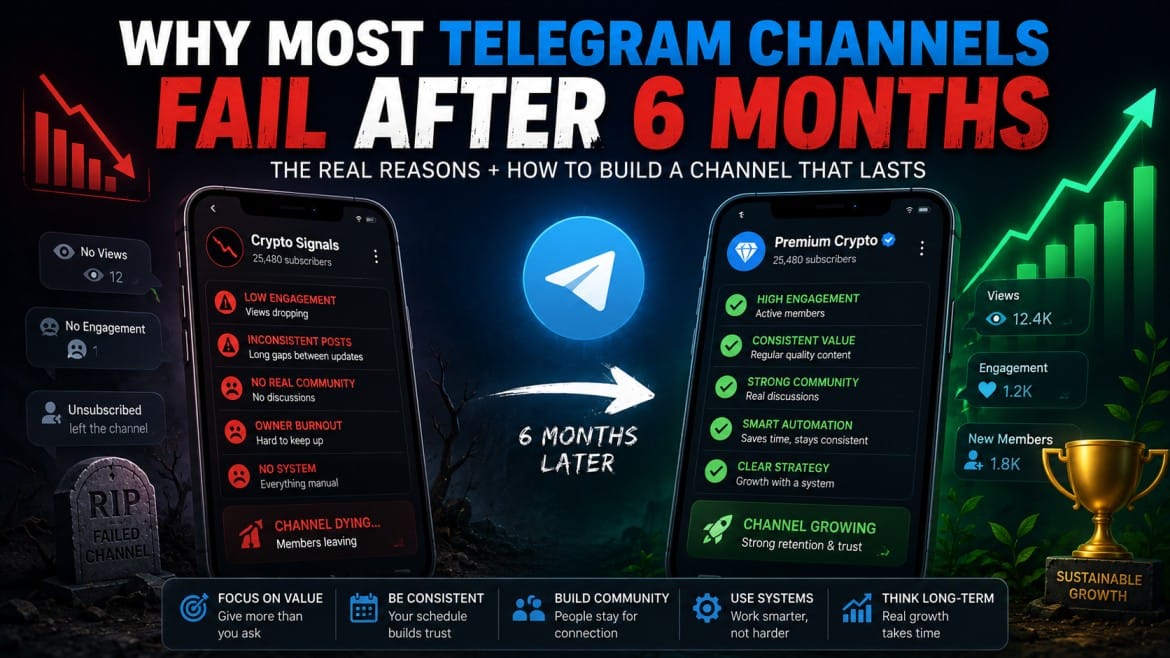
At the beginning, almost every Telegram channel feels exciting.
The owner posts constantly, engagement feels promising, new members join every day, and growth looks possible.
Then something changes.
Activity slows down.
Posts become inconsistent.
Engagement drops.
Members stop responding.
Growth becomes flat.
And eventually, many channels quietly die.
This happens far more often than most people realize.
In fact, the majority of Telegram channels never survive long-term. Not because Telegram stopped working — but because running a growing community becomes much harder after the initial excitement disappears.
The channels that survive beyond six months usually operate very differently from the ones that fail.
And most of the difference has nothing to do with luck.
Most Channels Start Without a Real System
A common pattern appears in failing Telegram channels:
Everything depends on motivation.
In the beginning, motivation is high. Posting feels exciting because the project is new.
But eventually:
- content creation becomes repetitive
- engagement slows down
- managing the channel feels exhausting
- consistency becomes difficult
Without structure, most channels slowly become inactive.
The channels that survive long term usually rely less on motivation and more on systems.
They build routines around:
- posting
- engagement
- scheduling
- workflows
- audience management
That structure is often what keeps channels alive during slower periods.
Many Channel Owners Underestimate Consistency
One of the biggest reasons Telegram channels fail is inconsistency.
A lot of admins disappear for days or weeks without realizing how damaging it is.
Telegram communities are habit-driven.
People continue checking channels when they expect regular value.
But once posting becomes unpredictable, users stop paying attention.
This is especially common in:
- crypto channels
- signal groups
- trading communities
- content channels
Many start aggressively during hype periods and vanish when momentum slows down.
The channels that survive usually maintain stable activity even during quieter periods.
Consistency builds trust.
Trust builds retention.
Growth Usually Slows Before It Improves
This is where many people quit.
In the first months, Telegram growth often feels exciting because:
- friends join
- early users engage heavily
- every new subscriber feels meaningful
But after that initial stage, growth typically slows down.
And psychologically, this is where many admins lose momentum.
They assume:
“The channel is failing.”
In reality, most long-term communities go through a slow middle phase before growth compounds.
The channels that survive usually understand that Telegram growth is rarely linear.
Momentum often comes later.
Most Channels Focus Too Much on Member Count
A surprising number of Telegram admins become obsessed with numbers.
But large member counts alone rarely create strong communities.
Some channels with thousands of members feel completely inactive.
Meanwhile, smaller channels with strong engagement often grow faster organically because members actually interact with the content.
The healthiest Telegram communities usually focus on:
- retention
- consistency
- trust
- engagement
- member experience
Not just vanity metrics.
Poor Content Quality Slowly Kills Retention
Many channels fail because their content eventually becomes repetitive.
People join Telegram channels because they expect:
- useful information
- entertainment
- insights
- updates
- community value
When posts start feeling lazy, rushed, or generic, retention declines slowly over time.
This is especially visible in channels that:
- repost constantly
- over-promote
- publish low-effort content
- repeat the same ideas daily
The strongest channels usually evolve continuously.
They improve:
- formatting
- clarity
- presentation
- content structure
- communication style
Small improvements compound over time.
Telegram Burnout Is Real
A problem many people never talk about:
Running a Telegram channel manually becomes mentally exhausting.
Especially once communities become larger.
Admins eventually start juggling:
- posting schedules
- community management
- updates
- moderation
- multiple channels
- audience expectations
Over time, this creates operational fatigue.
And burnout often leads directly to inconsistency.
Many channels do not fail because the niche is bad.
They fail because the admin becomes overwhelmed.
Most Growing Channels Use Systems Behind the Scenes
One pattern appears repeatedly among successful Telegram communities:
They operate systematically.
As channels grow, many admins start relying on tools and workflows to reduce manual pressure.
Not because automation replaces creativity — but because it protects consistency.
Platforms like BoostifyFox help Telegram admins simplify repetitive workflows such as:
- scheduling posts
- organizing multi-channel operations
- maintaining activity
- managing structured posting systems
The channels that survive long term usually become operationally organized long before they become large.
Managing a Telegram channel manually becomes exhausting over time.
Many Telegram channels fail because consistency becomes difficult to maintain manually. BoostifyFox helps simplify scheduling, content workflows, and multi-channel management so admins can stay organized and focused on growth.
Explore BoostifyFoxCommunity Experience Matters More Than Most People Think
A lot of Telegram channels treat members like passive viewers.
But strong communities usually feel interactive.
People stay longer when channels feel:
- active
- organized
- responsive
- human
- community-driven
This is especially important in niches like:
- crypto
- forex
- trading
- education
- media communities
Channels that create emotional connection usually retain members longer.
Channels That Over-Monetize Usually Decline Faster
Another common problem:
Trying to monetize too aggressively too early.
When every post becomes:
- promotional
- sales-focused
- affiliate-heavy
- conversion-driven
people eventually disengage.
The healthiest Telegram communities usually provide value first and monetize gradually.
Trust compounds slower than hype — but lasts much longer.
Many Telegram Channels Never Develop a Real Identity
Some channels fail because they never feel memorable.
They look and sound exactly like hundreds of other channels.
Successful channels usually develop:
- recognizable tone
- content style
- posting structure
- visual consistency
- community culture
Over time, this creates stronger brand identity and retention.
Most Long-Term Telegram Growth Comes From Retention
This is probably the biggest misconception about Telegram growth:
People think growth is mostly about acquisition.
But long-term success usually depends more on retention.
Because channels that keep members engaged naturally:
- grow through sharing
- create stronger loyalty
- maintain better engagement
- build momentum faster
Retention compounds.
And most failed channels never solve retention properly.
The Channels That Survive Usually Think Long-Term
One major difference separates surviving Telegram communities from failing ones:
Mindset.
Failing channels often chase:
- fast growth
- instant engagement
- short-term hype
Growing communities usually think about:
- sustainability
- systems
- audience trust
- consistency
- operational efficiency
That long-term approach changes everything.
Frequently Asked Questions
Why do most Telegram channels become inactive?
Many Telegram channels become inactive because owners lose consistency, struggle with burnout, or fail to build systems that support long-term content and community management.
How often should Telegram channels post content?
Consistency matters more than volume. Many successful channels maintain a stable posting schedule with regular updates instead of posting aggressively for short periods.
Why do Telegram channels lose engagement over time?
Engagement usually drops when content becomes repetitive, posting becomes inconsistent, or the channel stops providing meaningful value to members.
Do successful Telegram channels use automation tools?
As channels grow, many admins use workflow and automation tools to manage scheduling, maintain consistency, and reduce manual workload more efficiently.
What helps Telegram communities survive long term?
The strongest Telegram communities usually focus on consistency, retention, community experience, structured workflows, and audience trust rather than short-term growth alone.
Long-term Telegram growth depends on systems, not motivation.
Many successful Telegram communities rely on structured workflows to maintain consistency, reduce burnout, and keep engagement active over time. BoostifyFox helps channel owners manage Telegram operations more efficiently behind the scenes.
Learn MoreFinal Thoughts
Most Telegram channels fail after six months not because Telegram stopped working — but because maintaining a growing community is much harder than starting one.
The channels that survive usually focus on:
- consistency
- retention
- systems
- community experience
- operational structure
- long-term value
And as Telegram communities become more demanding to manage, more admins are quietly relying on tools like BoostifyFox to reduce operational pressure, maintain consistency, and build stronger long-term workflows behind the scenes.